Best Steel Grades for Induction Hardening
The best steel grades for induction hardening are medium and high-carbon alloy steels: EN8, EN19, EN24, 4140 and 20MnCr5. The rule is simple — the steel needs roughly 0.30–0.50 percent carbon to harden directly. EN19, EN24 and 4140 give the best balance of hardness (52–60 HRC) and core toughness.
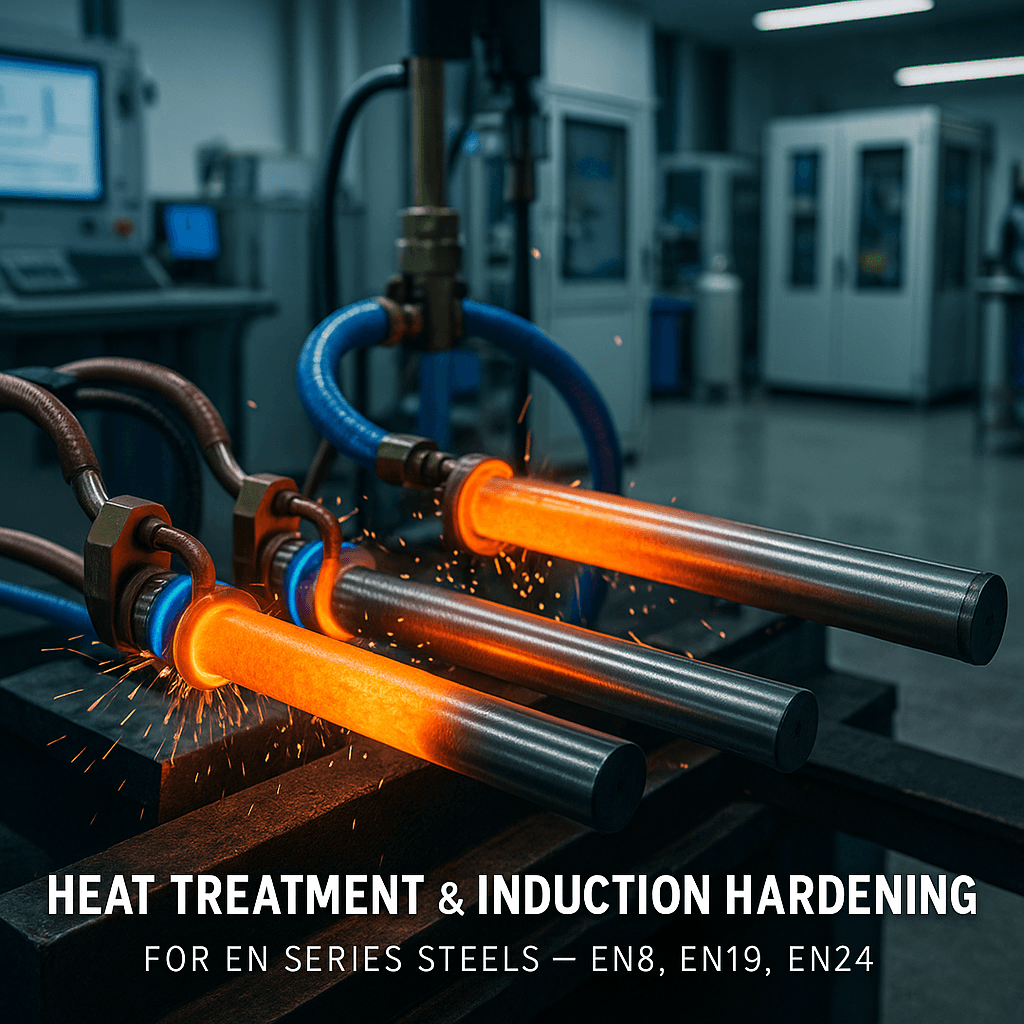
Choosing the right steel grade is the single biggest factor in whether an induction hardening job succeeds. Pick a steel with too little carbon and it will never reach the hardness you need; pick one that is too hard and brittle and the core may crack under load. For manufacturers and parts suppliers in Ludhiana and across Punjab, getting this choice right means longer component life, fewer rejections and lower cost per part.
Grade, HRC & best-use table
Here is an at-a-glance summary of the best steel grades for induction hardening, their typical carbon content, the surface hardness they reach, and where each one fits best.
| Steel Grade | Carbon / Alloy | Surface Hardness | Best Use |
|---|---|---|---|
| EN8 (080M40) | ~0.40% C (medium carbon) | 50–55 HRC | Economical shafts, spindles, light-duty gears |
| EN19 (4140) | ~0.40% C + Cr-Mo | 52–58 HRC | Crankshafts, axles, gears, high-stress shafts |
| EN24 (4340) | ~0.40% C + Ni-Cr-Mo | 55–60 HRC | Heavy-duty gears, drive shafts, aerospace-grade parts |
| 4140 (alloy) | ~0.40% C + Cr-Mo | 52–58 HRC | General-purpose shafts, rollers, hydraulic parts |
| 20MnCr5 | ~0.20% C (low carbon, carburize first) | 58–62 HRC (after carburizing) | Gears, pinions, pins needing a deep hard case |
Ranked from the best all-round performers to the most specialised choice:
- EN24 (4340) — highest hardness with the toughest core; best for heavy-duty gears and shafts.
- EN19 (4140) — the workhorse alloy; excellent hardness, machinability and value.
- 4140 — the international equivalent of EN19, ideal for general-purpose shafts and rollers.
- EN8 — the most economical medium-carbon choice for lighter-duty parts.
- 20MnCr5 — best where a low-carbon part needs carburizing before hardening.
What makes a steel suitable (carbon %)
Induction hardening works by heating the steel surface above its critical temperature (around 850–900°C) and then quenching it rapidly so the structure transforms into hard martensite. The hardness of that martensite is controlled almost entirely by one thing: carbon content.
- Below 0.25% C (mild steel) — too little carbon to form hard martensite. Will not harden by induction; must be case hardened or carburized first.
- 0.30%–0.50% C (medium carbon) — the sweet spot. Hardens directly to 50–60 HRC while keeping a tough core. EN8, EN19, EN24 and 4140 all sit here.
- Above 0.55% C (high carbon) — reaches very high hardness but becomes brittle and prone to quench cracking; needs careful control.
Alloying elements matter too. Chromium and molybdenum (in EN19 and 4140) improve hardenability, meaning the steel hardens deeper and more uniformly. Nickel (in EN24) adds toughness so the hardened part resists shock and fatigue. This is why alloy steels outperform plain carbon steels for demanding applications, even at the same carbon level. For the full method, see our induction hardening process guide.
If your base material is low in carbon, you are not out of options — it simply needs the carbon added at the surface first. That is the role of carburizing, explained in our comparison of induction hardening vs case hardening. For broader metallurgical best practice, the ASM International heat treating resources are a recognised authority.
Top steel grades ranked
EN8 — the economical medium-carbon choice
EN8 (080M40) is a plain medium-carbon steel with about 0.40 percent carbon. It hardens by induction to roughly 50–55 HRC, which is enough for many shafts, spindles and light-duty gears where extreme load is not a factor. EN8 is widely available, easy to machine and the lowest-cost option in this list, making it the default choice for general engineering parts. See our dedicated EN8 steel induction hardening service for specifications.
EN19 (4140) — the all-round workhorse
EN19, internationally known as 4140, is the most popular induction hardening alloy steel. With around 0.40 percent carbon plus chromium and molybdenum, it hardens to 52–58 HRC with excellent hardenability and a tough core. It machines well in the annealed state and resists wear and fatigue once hardened, which is why it dominates automotive crankshafts, axles, gears and high-stress shafts. Explore our EN19 steel induction hardening service for case depth and hardness options.
EN24 (4340) — the high-performance grade
EN24, or 4340, adds nickel to the chromium-molybdenum recipe, giving it the best combination of surface hardness (55–60 HRC) and core toughness in this group. It withstands shock, heavy loads and fatigue, making it the grade of choice for heavy-duty gears, drive shafts and demanding aerospace-grade components. It costs more than EN19 but pays back in reliability on critical parts. Learn more on our EN24 steel hardening page.
4140 — the international standard
4140 is the AISI designation that corresponds closely to EN19. It is specified worldwide for general-purpose shafts, rollers, hydraulic parts and tooling, hardening to 52–58 HRC. If your drawing calls out 4140 specifically, you can treat it the same way as EN19 for induction hardening. See our 4140 steel hardening service for details.
20MnCr5 — the carburizing grade
20MnCr5 is a low-carbon (around 0.20 percent) case-hardening steel. It cannot be induction hardened directly because it lacks surface carbon, but once carburized it forms a very hard case of 58–62 HRC over a tough, low-carbon core. This makes it ideal for gears, pinions and pins that need a deep, wear-resistant surface combined with shock resistance — common in tractor and transmission applications across Punjab.
Need a specific steel grade hardened in Ludhiana?
Get a quote from Thakur Industries. We harden EN8, EN19, EN24, 4140, 4340 and 20MnCr5 in-house with polymer and water-based quenching, hardness testing and case depth verification for automotive, agricultural and industrial parts.
Grade selection by application
The best grade depends on the load, geometry and budget of the part. Use this guide to match common components to the right steel.
| Application | Recommended Grade | Why |
|---|---|---|
| Crankshafts & camshafts | EN19 / EN24 | High fatigue strength with tough core |
| Transmission gears | 20MnCr5 / EN24 | Hard wear case plus impact resistance |
| Drive & output shafts | EN19 / 4140 | Balanced strength, machinability, cost |
| Light-duty spindles | EN8 | Adequate hardness at lower material cost |
| Hydraulic rods & pins | 4140 / EN24 | Wear resistance and surface integrity |
In practice, EN19 and 4140 cover the majority of everyday shafts and gears thanks to their balance of cost and performance. Step up to EN24 when the part is safety-critical or carries heavy fatigue loads. Reserve EN8 for budget-driven, lighter-duty work, and choose 20MnCr5 when a deep carburized case is essential. When you are unsure, get a quote and our metallurgy team will recommend the most cost-effective grade and process for your drawing.
Frequently asked questions
What is the best steel grade for induction hardening?
For most precision and load-bearing parts, EN19 (4140) and EN24 (4340) are the best all-round steel grades for induction hardening because they reach 55–60 HRC reliably and offer a tough alloy core. EN8 is the best economical choice for lighter-duty parts, while 20MnCr5 is best when the steel must be carburized first.
How much carbon does steel need for induction hardening?
A steel generally needs at least 0.30 to 0.35 percent carbon to harden directly by induction. Below that, there is not enough carbon to form hard martensite, so a low-carbon grade like 20MnCr5 must be carburized (case hardened) first to enrich the surface before quenching.
What HRC can EN19 and EN24 reach after induction hardening?
EN19 typically reaches 52–58 HRC and EN24 reaches 55–60 HRC after induction hardening and a low-temperature temper. The exact value depends on carbon content, quench severity and the temper used to balance hardness against toughness.
Is 4140 steel good for induction hardening?
Yes. 4140 is one of the most popular induction hardening steels worldwide. With about 0.40 percent carbon plus chromium and molybdenum, it hardens to 52–58 HRC, resists wear, and keeps a strong, ductile core for shafts, axles and gears.
Can you induction harden mild steel?
Plain mild steel (under 0.25 percent carbon) cannot be hardened effectively by induction because it lacks the carbon needed to form martensite. Such parts should be case hardened or carburized first, or you should switch to a medium-carbon grade like EN8 or EN19.
Which steel grades can Thakur Industries harden in Ludhiana?
Thakur Industries provides induction hardening job work in Ludhiana, Punjab for EN8, EN19, EN24, 4140, 4340, 20MnCr5 and other medium and high-carbon alloy steels, with polymer and water-based quenching, hardness testing and case depth verification.