Induction Hardening vs Case Hardening: Key Differences
The core difference in induction hardening vs case hardening is the mechanism: induction hardening physically heats a localized surface zone with an electromagnetic coil and quenches it, while case hardening chemically diffuses carbon or nitrogen into the surface. Induction is fast and precise; case hardening adds hardness to low-carbon steel.
If you are an industrial manufacturer or automotive parts supplier in Ludhiana or Punjab, understanding the difference between these two surface hardening methods will help you pick the right process for your components, control costs, and avoid premature wear or distortion.
Quick comparison table
Here is an at-a-glance summary of induction hardening vs case hardening across the factors that matter most when specifying heat treatment job work.
| Method | Induction Hardening | Case Hardening |
|---|---|---|
| Hardening mechanism | Physical heating by electromagnetic induction + quench | Chemical diffusion of carbon / nitrogen |
| Case depth | 0.5 mm – 5 mm | 0.2 mm – 2 mm |
| Distortion | Low (localized, short cycle) | Moderate (full part, long cycle) |
| Cost | Slightly higher per part | Lower for large batches |
| Best for | Shafts, axles, gears, pins (medium/high-carbon) | Gears, bearings, cams, bolts (low-carbon) |
How each process works
Induction hardening
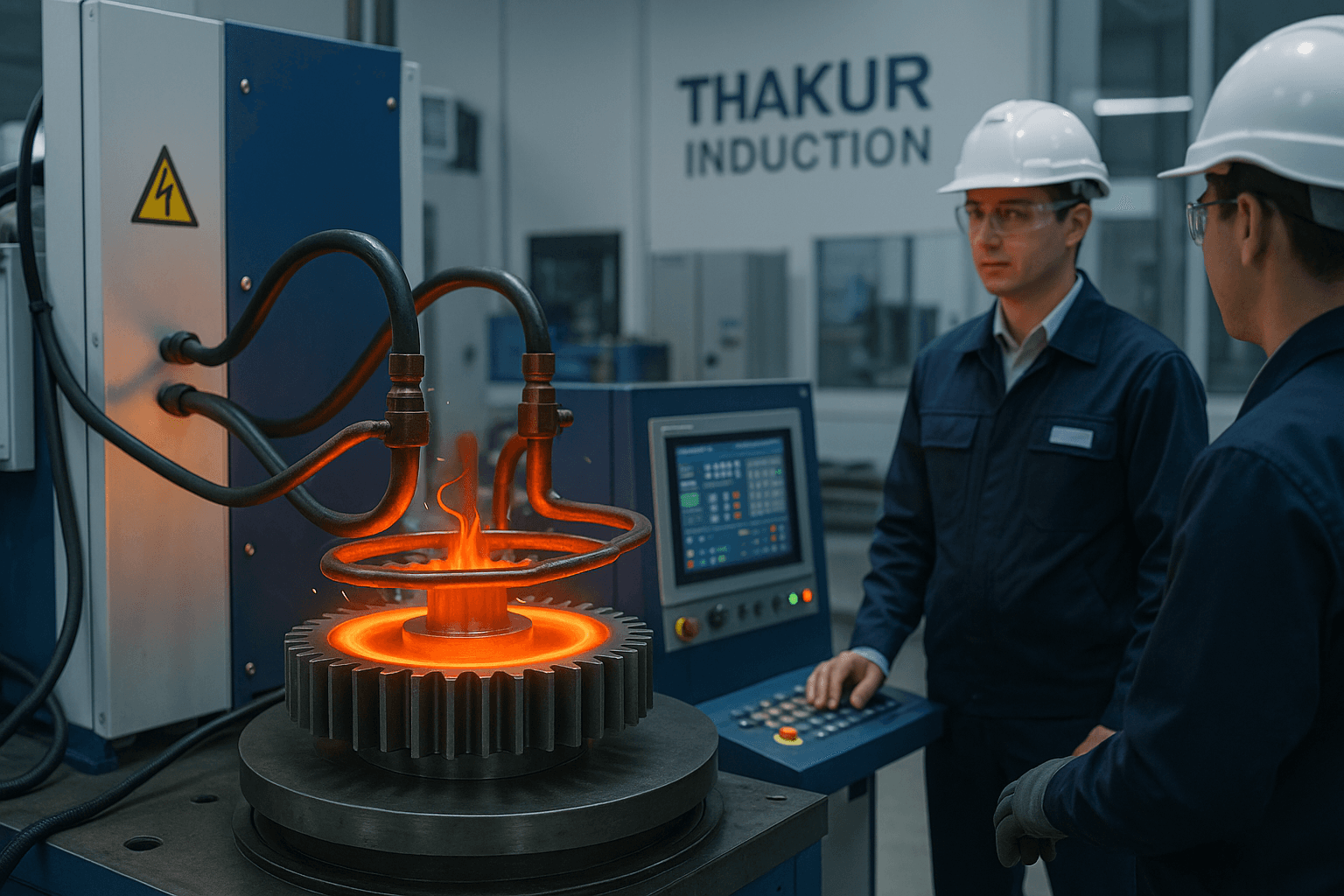
Induction hardening is a non-contact surface heating process that uses electromagnetic induction to heat specific areas of a metal part. The heated zone is then rapidly quenched using water or polymer solution, producing a hard surface with a tough, ductile core. You can read the full method in our induction hardening process guide.
- The component (gear, shaft, or pin) is placed inside a copper induction coil.
- An alternating current passes through the coil, generating heat through electromagnetic induction.
- The surface reaches the critical temperature (around 850°C).
- Immediate quenching hardens the surface layer while the core remains tough.
Because only the targeted zone is heated, induction hardening offers highly localized treatment, minimal distortion, and fast cycle times. It is compatible with EN8, EN19, EN24, 4140, and 4340 steels and is widely used across Ludhiana’s precision manufacturing sector for shafts, axles, gears, and pins. See our full induction heat treatment service for capabilities.
Case hardening
Case hardening (also called carburizing) is a chemical heat treatment process. Carbon or nitrogen atoms are diffused into the surface of the steel at high temperature, creating a hard, wear-resistant outer layer (the case) while the inside stays softer and more ductile. Explore our dedicated case hardening heat treatment service for material options.
- The part is heated in a carburizing or nitriding furnace.
- The outer surface absorbs carbon or nitrogen from the atmosphere.
- After sufficient time, the part is quenched to lock the hardened layer in place.
Case hardening delivers deep, chemistry-based surface hardening and is well suited to gears, pins, bolts, and bearings made of low-carbon steels. In Punjab’s heavy-duty manufacturing industries, it is preferred where components face friction, shock, or continuous wear in large production batches.
The key contrast worth remembering: induction hardening changes only the structure of the steel already present at the surface, transforming it to hard martensite, whereas case hardening changes the chemistry by enriching the surface with carbon before transformation. That is why induction requires a steel with enough carbon to harden on its own, while case hardening is the route of choice when the base steel is too low in carbon to harden directly. Both methods rely on rapid quenching to lock in hardness, and both can be followed by a low-temperature temper to relieve stress and improve toughness.
Distortion & cost
Distortion and cost are usually the deciding factors when choosing between the two processes. Their behaviour is shaped directly by how each method applies heat.
Distortion
Induction hardening keeps distortion low because heat is confined to a thin surface zone and the part spends only seconds at temperature. Case hardening soaks the entire component at furnace temperature for hours, giving it a moderate distortion risk; tight-tolerance parts often need finish grinding afterwards. For precision shafts and gear teeth, lower distortion is a major reason engineers favour induction.
Cost
On a per-part basis, induction hardening can cost slightly more because each component is processed individually with a dedicated coil designed for its geometry. Case hardening becomes more economical at volume, since dozens of parts share a single, long furnace cycle and the per-piece overhead drops sharply. However, induction’s short cycle times, low scrap rates from distortion, and reduced finishing work often close that gap for precision parts. The right choice balances batch size, material grade, tolerance, and the value of the finished component. When in doubt, get a quote and we will recommend the most cost-effective route for your specific parts.
When to choose which
The choice between induction and case hardening depends on the part’s application, material type, and load conditions.
Choose induction hardening if:
- You need precision hardening in specific zones (e.g., gear teeth or shaft ends).
- The part is made of medium or high-carbon alloy steel.
- You require tight tolerances and minimal distortion.
Choose case hardening if:
- The part is low-carbon steel requiring a deeper carbon-enriched case.
- You want bulk treatment for many components simultaneously.
- You need cost-efficient heat treatment for large batches.
For a deeper look at controlling hardened-layer thickness, see our guide on case depth control in induction hardening. For broader best practice, the ASM International heat treating resources are a recognised authority.
Need case hardening or induction hardening in Ludhiana?
Get a quote from Thakur Industries — we run both processes in-house with polymer and water-based quenching, hardness testing, and case depth verification for automotive, agricultural, and industrial parts.
Applications in industry
| Component Type | Recommended Process |
|---|---|
| Automotive shafts and axles | Induction Hardening |
| Gears and sprockets | Case or Induction Hardening |
| Agricultural tools and blades | Induction Hardening |
| Fasteners and bolts | Case Hardening |
| Bearings and cams | Case Hardening |
In short, both methods strengthen steel surfaces — but induction hardening excels in precision, repeatability, and low distortion, while case hardening is ideal for mass treatment and deep chemical hardening of low-carbon parts. If you need either service in Ludhiana, Punjab, Thakur Industries delivers both with controlled quenching so your components perform at their best.
Frequently asked questions
What is the main difference between induction hardening and case hardening?
Induction hardening uses electromagnetic induction to physically heat and quench a localized surface zone, while case hardening chemically diffuses carbon or nitrogen into the surface. Induction is fast and localized; case hardening is slower but treats the whole exposed surface.
Which process causes less distortion?
Induction hardening generally causes less distortion because heating is localized and the cycle is short. Case hardening exposes the full part to furnace temperatures for hours, giving it a moderate distortion risk that may require post-treatment grinding.
Is case hardening or induction hardening cheaper?
Case hardening is usually more economical for large batches of low-carbon parts because many components are treated together in one furnace cycle. Induction hardening can cost slightly more per part but is faster and ideal for precision, high-value components.
Which steels suit each process?
Induction hardening works best on medium and high-carbon alloy steels such as EN8, EN19, EN24, 4140 and 4340. Case hardening suits low-carbon steels like 20MnCr5 that need carbon added to the surface to become hard.
Can Thakur Industries do both processes in Ludhiana?
Yes. Thakur Industries provides both induction hardening and case hardening job work in Ludhiana, Punjab, with polymer and water-based quenching, hardness testing and case depth verification for automotive, agricultural and industrial components.